France advances Hypairion project for open AI combat aviation architecture
France is launching the Hypairion project to develop a state-controlled, open and modular AI architecture for combat aviation.
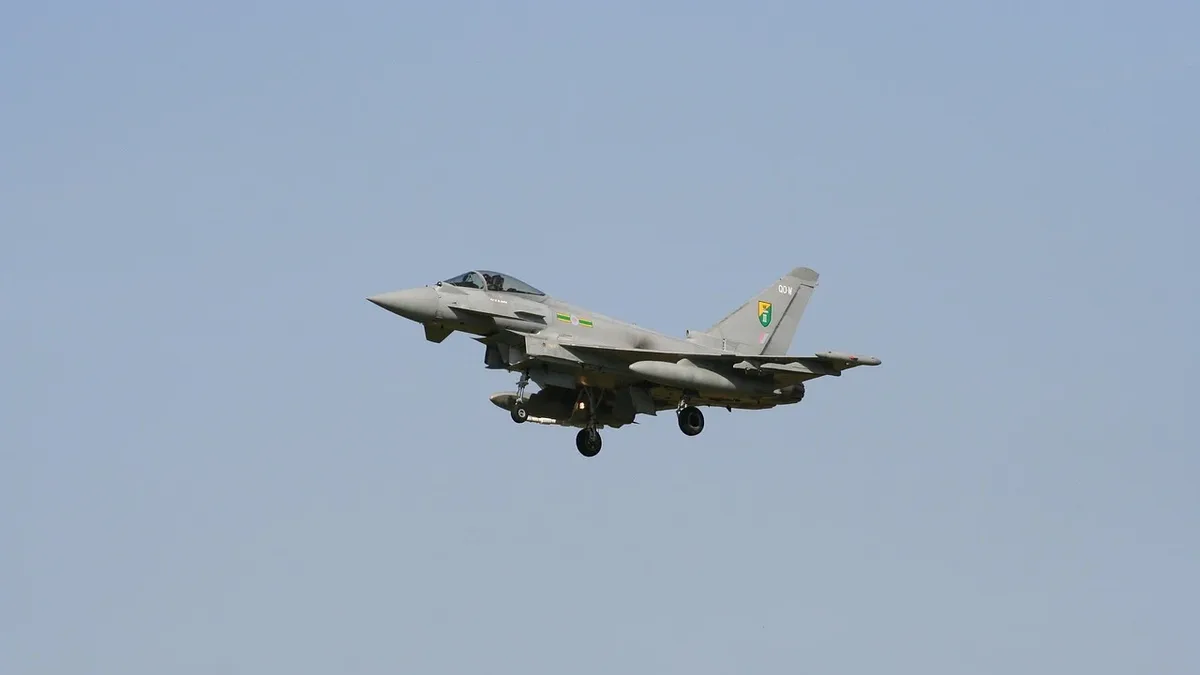
France plans to fly crewed fighter jets in collaboration with combat drones in 2028 as part of the Hypairion project to experiment with AI in combat aviation. The initiative seeks to create an open, modular architecture for combat aviation and AI under full state control, involving collaboration between the Air Force, the Directorate General for Armament (DGA), and the Ministerial Agency for Defence AI (Amiad). This push for sovereign AI aims to reduce reliance on private companies for critical systems and keep core technology under government ownership.
Col. Cédric, head of the Air Force capability-development office, stated the project's core objective. "What Hypairion is really about is equipping the Air Force and our platforms with architectures that are open, modular and owned by the government," he said. The goal is to break free from proprietary systems that lock down sensors and weaponry. Amiad will provide sovereign AI for command and control and mission autonomy, proposing an industrial hub where traditional aerospace firms and startups can interact.
Col. Thibault, deputy director for AI applications at Amiad, emphasized the state's role. The point of the project is for the French state to retain control of the overall architecture and to be able to integrate the most capable startups or industrial companies. Companies might join and leave, but Hypairion will retain capabilities in-house. Officials envision future platforms as 'flying computers' where software can be updated between missions to adapt to threats. They stress that humans, augmented by AI, will retain ultimate tactical judgment and operational assessment.
Technology testing and Rafale integration pathway
The French Air Force is modifying two Mirage 2000 fighter jets at the Mont-de-Marsan airbase to serve as AI test beds. A new computer is being added to test all kinds of use cases, with trials starting by the end of the year. This first stage will focus on assessing energy consumption and system interfacing, not creating a ready combat capability. Initial AI applications may include optimizing flight paths or supporting tactical decisions on weapon deployment.
Development will be incremental, building on the current Rafale F4 standard, which already features an initial level of openness via a tablet connected to the mission system. Work on controlling autonomous platforms will occur within this F4 standard before 2033. The DGA has set a target date of 2033 for the first version of the Rafale F5 standard.
The F5 standard aims to manage the phenomenal cognitive load on crews and maintain operational superiority. It will broaden data available to the tablet, grant it access to mission system computing resources, and improve interfacing with onboard communication systems and data links. General Engineer of Armaments Sébastien, in charge of the Rafale program at the DGA, noted this will make it possible to control autonomous combat platforms from the Rafale without waiting for the F5 deployment. The unmanned aircraft for the 2028 test will be a platform for experimentation, not necessarily the final wingman drone for the Rafale F5.
Broader context of loyal wingman development
While France develops its sovereign approach, other nations and companies are advancing similar concepts. Airbus, BAE Systems, General Atomics, and Anduril are all developing collaborative combat aircraft, often called loyal wingmen, in Europe and the United States. The Hypairion architecture specifically aims to separate flight-safety systems from mission capabilities.
Mission autonomy in this context is defined as AI that assists pilots with mission planning, in-flight decisions, and post-mission analysis. Amiad already applies similar AI principles in the French Army’s Pendragon robotics project. The broader Hypairion roadmap will cover usage concepts, doctrine, workforce scaling, and equipment to prepare the French Air Force for future combat environments. The French military emphasizes that decisions on weapon use will remain with human operators.
The first stage of Hypairion will focus on assessing energy consumption and system interfacing using the upgraded Mirage 2000 test beds at Mont-de-Marsan by the end of the year.