US Navy Seeks Carrier-Based Uncrewed Combat Aircraft
The US Navy has issued a Request for Information for a carrier-based Collaborative Combat Aircraft to add mass to its air wings and operate in high-risk
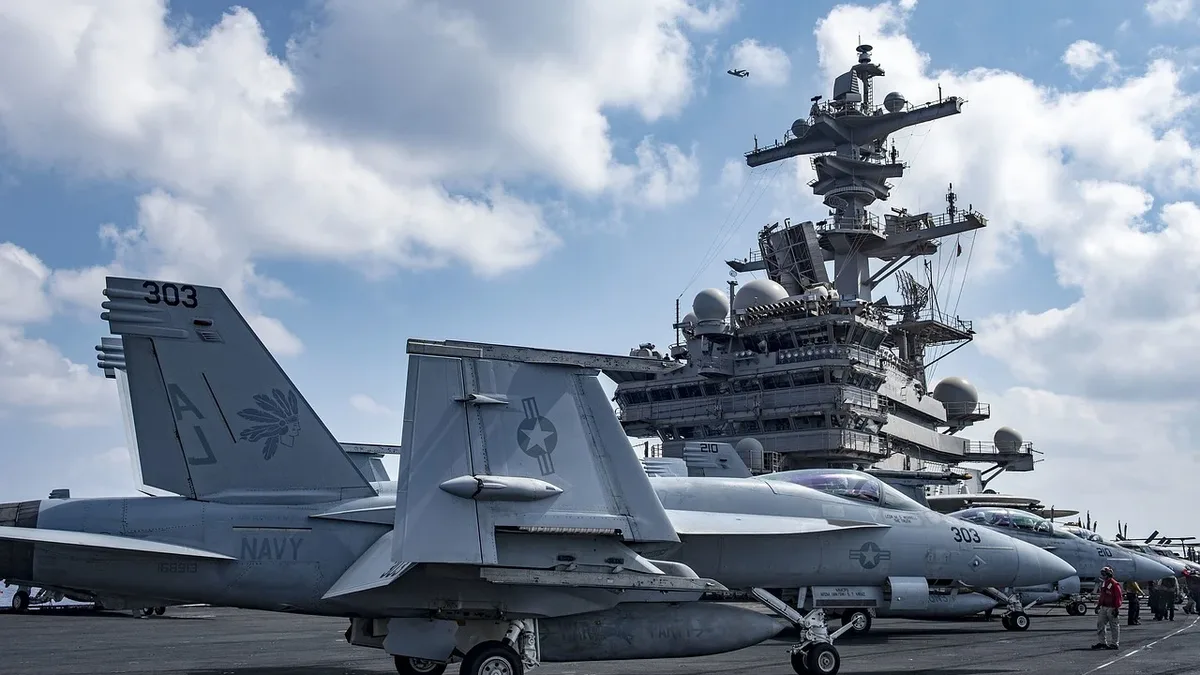
The US Navy has formally requested information on a new carrier-based uncrewed combat aircraft. A Request for Information was published on August 31 by the Navy's Future Advanced Capability Program Office, seeking a Collaborative Combat Aircraft to fill capacity gaps.
The goal is to field an autonomous fighter that provides more mass for carrier air wings. This aircraft would operate in environments considered too high-risk for manned platforms. It is intended to fly alongside the F/A-18E/F Super Hornet and the F-35C Lightning II.
Key Design Requirements
The RFI outlines critical specifications for the new aircraft. It must be able to carry up to four munitions in the 2,500-pound class. The design must integrate into existing Navy command-and-control systems and cooperate with both manned and unmanned assets.
Notably, the Navy is open to designs without internal weapons bays. This suggests a willingness to accept reduced stealth for lower production costs. The aircraft's physical footprint must be roughly equivalent to an F/A-18E/F Super Hornet.
| Requirement | Specification |
|---|---|
| Munitions Capacity | Up to four 2,500-pound class weapons |
| Stealth Feature | Internal weapons bays not mandatory |
| Size Footprint | Roughly that of an F/A-18E/F Super Hornet |
| Operational Environment | Capable up to Sea State 5 conditions |
| Landing System | Must use existing Joint Precision Approach and Landing System (JPALS) |
Expedited Development Path
The Navy is pushing for a rapid development schedule. To speed fleet integration, the aircraft must use the current Joint Precision Approach and Landing System for carrier landings. The service also allows the use of commercial off-the-shelf components that are not initially marinized, provided vendors show a clear plan to make them sea-worthy.
Structural and logistical compatibility is essential. The CCA must work with standard shipboard tooling and logistics systems. Over time, the selected platform will integrate with future carrier fighters as the more affordable part of a high-low capability mix.
The Evolving Carrier Air Wing
This initiative is part of a broader transformation of the carrier air wing. Other uncrewed systems are also expanding their roles. As highlighted in recent Naval News reporting, scale models of the MQ-25 Stingray tanker have demonstrated configurations armed with Long Range Anti-Ship Missiles.
Meanwhile, other parts of the air wing are undergoing major transitions. The C-2A Greyhound completed its final flight in late July after 60 years of service. Its Carrier Onboard Delivery mission has now passed to the CMV-22B Osprey. Legislative proposals in the National Defense Authorization Act aim to secure multi-year procurement for up to 12 additional E-2D Advanced Hawkeye aircraft.
However, concerns persist about the timeline for replacing manned fighters. The Navy's next-generation F/A-XX program remains shrouded in silence. With Super Hornets aging and F-35C procurement rates described as modest, delays could create future readiness gaps.
A Transatlantic Trend
The US Navy is not alone in pursuing carrier-based collaborative combat aircraft. Major European navies are on similar paths. In June 2026, France's defense procurement agency issued an RFI for a carrier-capable collaborative combat UAV system. It aims to field loyal wingmen to operate alongside the Rafale M F5 and on the future PANG aircraft carrier.
The Royal Navy is advancing its own strategy under Project Vanquish. This effort is progressing toward flight demonstrations of fixed-wing Autonomous Collaborative Platforms from a Queen Elizabeth-class carrier. The goal is to enable a hybrid air wing by 2040.