China's Second UUV Mothership Spotted in Guangzhou
A second Chinese naval auxiliary vessel, speculated to be a mothership for large unmanned underwater vehicles, has been identified in Guangzhou.
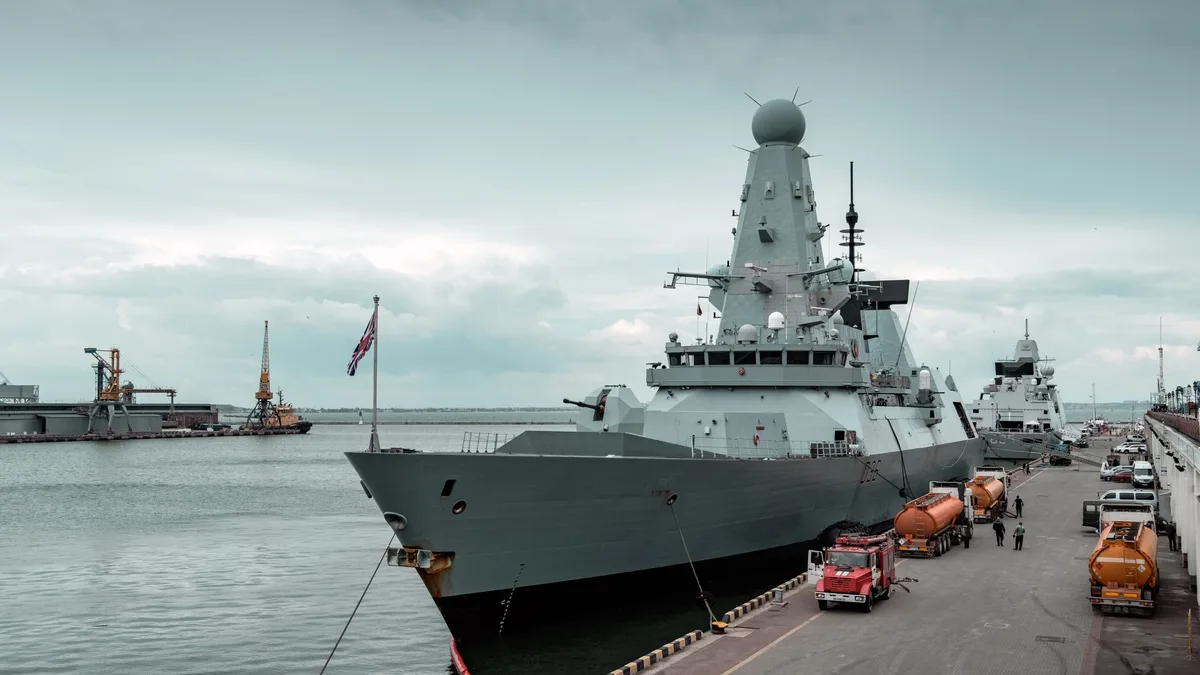
New imagery shows a second Chinese naval auxiliary vessel in Guangzhou, speculated to be a UUV mothership. Stills from social media video show the new vessel under tow in the Pearl River, with scaffolding and missing equipment indicating early-stage fitting-out.
The footage originated on Chinese social media platform Weibo before spreading to other platforms. While its authenticity remains unconfirmed, AI detection tools suggest the material is genuine, with possible superficial enhancements. Several tugboats were towing the vessel near the Panyu district, with the GAEI headquarters visible in the background.
Design Contrasts with Shanghai-Built UUV Mothership
The Guangzhou vessel features a shorter, narrower hull with an estimated length closer to 150 metres. This contrasts sharply with the Shanghai-built vessel, which exceeds 200 metres. The stern configurations are also markedly different.
Both designs share a raised forward deckhouse with the bridge at the front and a large rear opening leading to a hangar-like area. Their propulsion layouts are similar, with side-by-side smokestacks for diesel engines. Both also feature an opening similar to a well deck gate at the stern. The Guangzhou vessel is about a third smaller overall than its Shanghai counterpart.
Likely Built at COMEC/GSI Shipyard on Longxue Island
The vessel's origin is traced to the COMEC shipyard, formerly known as Guangzhou Shipyard International (GSI), on Longxue Island. This facility is a subsidiary of the China State Shipbuilding Corporation (CSSC). Archival satellite imagery from October 2nd shows the vessel peeking out of a covered graving yard at GSI prior to launch.
COMEC has a history of building auxiliary and support vessels for the PLAN. Its recent projects include amphibious barges, fleet replenishment ships, and new types of submarine support vessels. The yard also launched the first hull of a new, large supply vessel design and is building a second with a displacement around 65,000 tons. Other notable builds include an experimental carrier-like flattop for UAV evaluation and the third unit of the Type 920 hospital ship, commissioned in 2025.
The builder's identity and the destination for further fitting-out work require additional imagery for confirmation. At least two other Huangpu shipyards further up-river are plausible candidates for completing this work.
Strategic Implications for UUV Operations
Both vessels are designed to launch and recover large unmanned underwater vehicles via a stern well deck and lifting pylons. This capability allows for deploying UUVs far from Chinese shores, offering an asymmetric advantage in undersea warfare. Satellite imagery suggests China is evaluating at least two very large UUV designs between 35 and 45 metres in length, which would be the largest known military UUVs in the world.
Large, long-range UUVs can be used for mapping, hunting submarines and ships, mine searching, and launching cruise missiles or drones. For China, these systems could pose a credible threat to U.S. outposts deep in the Pacific. The U.S. Navy has no similar vessel in its inventory, with launch and recovery of large UUVs remaining a conceptual work in progress.
The emergence of two distinct designs in quick succession signals an accelerated and diversified approach to China's uncrewed underwater warfare capabilities. There are rumors that these vessels are part of a larger program to build more ships with similar capabilities. If more ships are added, a clearer picture of the PLAN's large UUV plans and expeditionary potential will emerge. Further assessment awaits more detailed imagery to clarify the intended purpose of these vessels.