U.S. Navy Tests Blackbeard Hypersonic Missile on Super Hornet
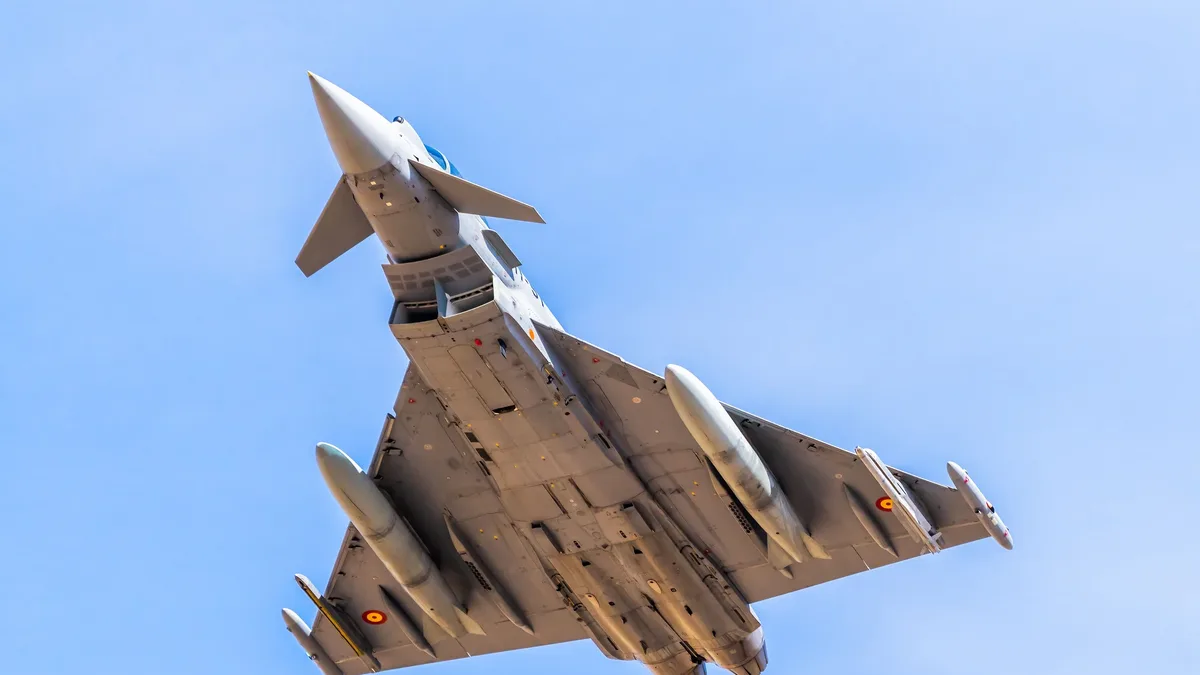
The U.S. Navy has conducted a captive-carry flight test of the Blackbeard hypersonic missile using an F/A-18E/F Super Hornet.
The U.S. Navy flew two Blackbeard hypersonic missile test articles beneath an F/A-18E/F Super Hornet in a recent captive-carry flight at Naval Air Station Patuxent River, Maryland. This developmental test, where no weapons were released, marks tangible progress toward achieving an Early Operational Capability. The aircraft and both test articles returned safely to the airfield.
Programme structure and strategic intent
Blackbeard is being developed by California-based Castelion under the Navy’s Multi-mission Affordable Capacity Effector (MACE) programme. The effort is led by the Future Capability Development and Integration Aviation Rapid Capabilities Cell within the Portfolio Acquisition Executive Aviation, with involvement from the Naval Air Warfare Centers and the Department of the Navy Rapid Capabilities Office.
The weapon is intended to give carrier-based strike fighters a responsive, high-speed option for penetrating contested anti-access/area-denial environments. It is described as a highly maneuverable, low-cost tactical hypersonic weapon, not a long-range strategic system. Its strategic goal combines speed above Mach 5 with a compact payload and a lower production price, aiming to provide a weapon that can be purchased and expended in greater numbers than costlier alternatives.
Acquisition innovation and industrial scaling
The flight test demonstrates progress under acquisition policy reforms in the 2026 National Defense Authorization Act and the Department of War’s Acquisition Transformation Strategy. The partnership between the rapid capabilities cell and Castelion bypassed legacy administrative constraints, moving at a record pace to transition advanced, dual-use commercial technologies.
This public-private model leverages private venture capital to absorb early research and development risk, aiming to bridge the procurement 'valley of death' for non-traditional defense firms. The program aligns with a strategy to develop cost-effective, rapidly fieldable kinetic mass. Castelion’s reported full-rate production price goal is less than $300,000 per weapon. The company plans to manufacture its own rocket motors, flight computers, actuators, and seekers to reduce external supplier dependence. Discussions have included the authority to acquire up to 12,000 missiles over five years.
| Development Aspect | Detail |
|---|---|
| Reported Unit Cost Goal | < $300,000 |
| Early Prototype Order (Jun 2026) | 50 units for $23.4 million |
| Initial Production Ceiling | Up to $200 million |
| Earlier Development Funding | ~$50 million + $105 million for integration |
| Proposed Annual Capacity | At least 500 missiles |
Near-term path and remaining challenges
Blackbeard will continue developmental flight testing at NAS Patuxent River as it progresses toward future live-fire milestones. The reported aim is to achieve a limited early operational capability by August 2028, though an earlier 2027 target was previously mentioned. Live-fire trials, flight-safety certification, carrier qualification, and proof of consistent performance under naval aviation constraints are still required. External carriage beneath the Super Hornet is the demonstrated configuration; integration with the F-35, including internal bay fit, remains a separate question.
Vice Adm. John 'Doc' Dougherty IV stated, "This flight of Blackbeard is another significant milestone as we progress toward EOC, providing a critical capability pathway for theater deterrence." Until live launches establish separation behaviour, guidance, and terminal effectiveness, Blackbeard remains a capability under development.
Technical design and operational implications
Images suggest a two-stage design with fins on both sections, shaped for high-speed atmospheric flight. The visible nose aperture is consistent with a seeker window, though the final sensor configuration-electro-optical or Ku-band radar-is unresolved. Midcourse navigation for striking mobile targets is also an unsettled element. The original MACE requirement described a warhead of about 34 kilograms; Castelion-related material discusses a compact reactive-material concept but does not confirm its adoption.
The Navy’s choice of the Super Hornet leverages its existing presence in the carrier air wing. For Indo-Pacific operations, Blackbeard offers potential to distribute rapid anti-ship strike capacity across carrier aircraft, land launchers, and unmanned vessels. If manufacturing meets ambitions, a larger inventory could allow repeated strikes and widen crisis response options. A shortfall would constrain capability by magazine depth. Blackbeard will continue developmental flight testing at NAS Patuxent River as it progresses toward future live-fire milestones.